
We all know. We all feel it.
Great changes are happening everywhere, and everyone is affected. We see and feel the changes socially, politically, and environmentally. Globally, the climate is changing and so are our lives. We know that positive change is desperately needed, but we have so far to go. Where do we start?
As we do our best to find a good path, the chaos continues to swirl around us. This is unsettling and we can easily find ourselves lost in the latest news, becoming overwhelmed and feeling hopeless. Amidst this storm, how can we find a quiet space to restore ourselves? How can we find our calm, our balance, and the positive energy to continue?
From the headline above, you can guess my answer is “meditation.” But how does that work? Ten years ago, before I started practicing, I would have been skeptical. My old self would have said, “OK, sure; meditation might help but I’ve tried it a few times, and I can’t do it. I have no idea how to ‘think about nothing’.”
That’s the way everyone feels before they start practicing. Meditating is a skill that humans develop − like talking, walking or eating spinach. None of us knew how to do those things when we were born, but we tried, we practiced and we learned. Now many of us can even talk, walk, and eat − all at the same time.
Meditation is a mind-body practice that trains attention and awareness to achieve a calm, clear and stable state, helping to reduce stress, anxiety, and improve focus. We already know how to do many things with our body and our mind and so learning to meditate is relatively easy by comparison. And fun.
I teach the practice of Sheng Zhen Meditation; a new form of qigong that evolved over centuries in China but is certainly suited to these times of great transformation. Its purpose is to open human hearts and connect to the power of qi (or chi/ki), the life force that many believe animates everything and connects the body to the universe. Every living being is thought to be connected to the flow of qi. The flow of qi gives us life and keeps us alive. When it stops flowing through us, we die. Sheng Zhen (pronounced “shung jen”) can be translated into English as “open heart” or “unconditional Love.”
A millennium ago, the ancients who first developed an understanding of qi also invented qigong practices to improve its flow. In Chinese, “gong” means “work” or “cultivation”, so qigong refers to the practices humans have created to cultivate their life force, to strengthen and enhance it. The creators wisely realized that improving their life force would help them with everything they did.
Over time, many different qigong practices were developed – the different forms of yoga and meditation, the martial arts of tai chi, aikid, karate, and more are all types of qigong. So, what’s special about Sheng Zhen? And why haven’t we heard of it like all those other practices?
Sheng Zhen is new, only 30 years old, and I am one of the 200-ish teachers worldwide who have been trained directly by Master Li, the teacher of this practice. We don’t have a big footprint yet, but our practice is special because it was made for these times.
We all need big help, and time is of the essence. Sheng Zhen doesn’t require us to work for years and years to finally get “there”. We can enjoy the benefits of meditation right away. It only gets better the more we practice. Sheng Zhen quickly and easily empowers people to connect to the source of qi and improve the flow of their life force.
Sheng Zhen’s comprehensive system of moving forms, still meditations and philosophy taps into the body’s natural ability to heal itself. The graceful, flowing movements relax and strengthen us physically, while quieting the mind and the heart. Practice reduces stress and balances emotions, so that we can find our center amidst all the external upheavals. Most importantly, we gain the skill to fill our heart with joy and energize our spirit any day, anytime, no matter how the winds of change may blow.
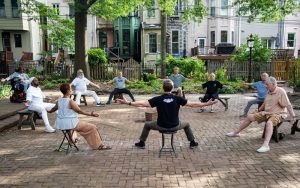
During 2026, I encourage you to do something good for yourself: give Sheng Zhen meditation a try. Our class meets every Tuesday and Thursday from 5-6 p.m. in Fellowship Hall at Brown Memorial Presbyterian Church.
For more information, visit the Sheng Zhen Maryland website here.
–Peter Van Buren
