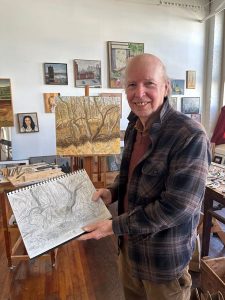
 With the fresh memory of the magnolia trees in bloom, and the fountains and parks coming to life, it is a good time to appreciate the art of our Bolton Hill neighbor Jimmy Rouse. The picturesque streets of Bolton Hill and nearby neighborhoods in which he has lived and worked have been the subject of his art since the beginning of his career.
His body of work includes representations of familiar places. John Street Park has been the subject of quite a few paintings, and the streets and parks of Mt. Vernon have been featured in woodcuts. His landscapes and cityscapes are detailed, with color variation and accurate rendering of trees, shrubs and foliage. Many are explicitly of the seasons, the foliage, the blooms, with some representing the colors and flowers of spring and others exploring the changing leaves of autumn. These works live within the school of maximalism; more is more. The canvases are vibrant, bold and intricate.
Rouse began painting in his early twenties and has been painting every day since. Describing himself as somewhat “self-taught,” he did spend a year studying at MICA, where Raoul Middleman was his teacher. “I wanted to know how to draw. I love to draw. It’s really the basis.” With Middleman, he studied the old masters at the National Gallery, and this was one of his paths into developing his drawing and representational skills.
Rouse is strictly interested in making representational art. To him, abstract art “denies images, has a limited vocabulary and best conveys emotions.” He believes the abstract expressionists “painted themselves into a corner.” Thus, Rouse’s body of work is all representational, yet it is diverse in subject matter. He is accomplished in landscapes, cityscapes, still lives, portraits, and allegorical compositions that tell a story. “If you are able to create using representational images, it’s self-sustaining.”
Born in Baltimore, he attended the Gilman School and graduated from Yale University with a degree in political science in 1967. After college, he took on various “art habit” jobs, including a stint at the legendary Martick’s Restaurant Francais. He made a name for himself with Louie’s Bookstore Cafe on Charles Street (named after his son), which he owned and operated from 1981 to 1998. It wasn’t just a restaurant; it was a sanctuary. It was a place where patrons could browse for a new novel, listen to a classical quartet and enjoy a meal surrounded by local art. It was there that Jimmy’s dual roles as a creator and a community-builder truly crystallized. When his employees struggled with unreliable buses, he co-founded Transit Choices, an organization that advocates for an improved mass transit infrastructure for Baltimore.
To this day Rouse works on Transit Choices projects each weekday morning, before heading to his Clipper Mill studio to make art. He continues to use his rowhome on John Street, which for many years was also his home, as a second studio. That’s where his assistant stretches his canvases and helps with other aspects of his art endeavors. Otherwise, Rouse’s life revolves around his Baltimore County farm, where he lives with his partner of thirty-six years Ava Oelke, who sings jazz, folk and country with two bands. She also cultivates flower gardens on the property and stables two horses. The Rouse and Oelke family life is full, with four adult children and nine grandchildren.
At 80, he speaks of his later years with the same poetic grace he applies to his landscapes. In his recently published artist monograph, Rouse expresses a desire to “go out as a spectacular sunset” by creating the most beautiful work of his life. The monograph, titled Jimmy Rouse: Works from 1968-2025, is itself a work of art, complete with hi-res images and commentary on specific work and overall philosophy of art. Copies can be purchased at the BMA museum store as well as local bookshops. Additional images of Rouse’s work can be seen on the BHCA social media pages.
To see a complete catalogue go to his website at https://portfolio.jimmyrouse.com/. And go to Transit Choices to learn more about advocating for better Baltimore public transportation.
–Francine Marchese
 Download PDF