
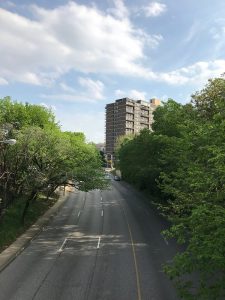
When one thinks today of Bolton Hill or describes it to a friend, it’s likely to reflect a bias for what the City of Baltimore website calls its strong Victorian-era, traditional row house character with relatively intact blocks of structures from the middle-to-late-19th Century. A few of those buildings date back to pre-Civil War times.
No one talks much about the “new” Bolton Hill: the hundreds of row houses and apartment units constructed in the 20th Century. The advent of that “new” construction dates to the early 1960s and seemingly ended with the opening of Spicer’s Run, the gated community opened in 1998 on the neighborhood’s northern boundary.
Our intrepid neighborhood historian, attorney Kevin Cross, takes a deep dive into the origins of 10 real estate developments that more than doubled the neighborhood population. It raises but does not answer the question: Is Bolton Hill expansion over, frozen in time?
Within our long-established boundaries there remains at least one big plot available for significant new construction: the three-acre vacant site of Eutaw-Marshburn Elementary School, closed and empty since 2023. The city makes occasional noises about releasing the property and at least one local developer has expressed interest. Stay tuned.
For almost 300 years, the people of Baltimore—a kaleidoscopic mix from the beginning—have been building and rebuilding their city. … As the community has grown, as tastes have changed, as business has evolved and technology advanced, Baltimoreans have built and razed buildings, opened and closed streets, and restored and demolished whole neighborhoods.
– from the introduction to Then & Now: Baltimore Architecture (2006), by Charlie Duff & Tracey Clark
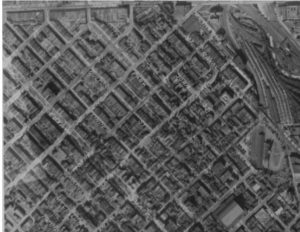
In late 1926 and early 1927, aerial photos of Baltimore were snapped from a surveying airplane, including this composite image of Bolton Hill:
In 1964, another plane passed over the neighborhood, capturing the dramatic changes since the earlier photos:
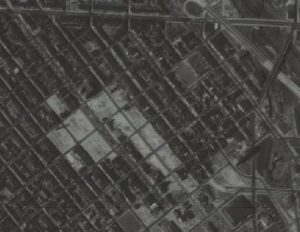
The light-colored parts of the 1964 photo show entire blocks razed for “Urban Renewal,” when dilapidated structures, mostly along Linden Ave., were demolished to make way for modern homes.
In follow-up to the September 2025 Bulletin article showing 1950s and 1960s photos by R. Julian Roszel, Jr., it might be useful to survey the various “modern” housing developments, some of which are now more than 60 years old themselves – not so modern anymore.
1. Sutton Place – 1962/1963
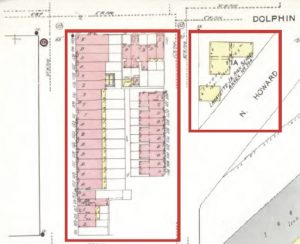
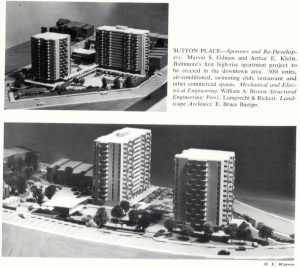
The 300-apartment tower at 1111 Park Ave. was the first new housing project in Bolton Hill in the modern era, originally called Sutton Place. “The Sutton” – now known as “Renew Mt. Vernon” – sits east of Park Ave., immediately south of Dolphin Ln. (formerly known as Dolphin St. there), and this 1952 Sanborn map with added red boxes shows the houses and buildings previously occupying that space:
Originally, the Sutton was proposed to be two towers:
It was by design that the commercial storefronts face Howard Street, according to a February 1961 Baltimore Sun article, to accommodate Bolton Hillers’ concerns about “creeping commercialism.” A September 1963 Sun article pointed out that the white marble steps at the upper entrance, supporting lamp posts now, were stoops found on site after the earlier houses were demolished, and the band of red bricks were pavers previously used for the surface of Howard Street.
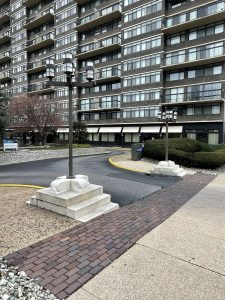
The Sutton had a dinner theater open there in 1969, and in October of that year it hosted a fashion show narrative by the actress Joan Crawford. According to former Bolton Hillers Richard Stein and Dino Sangiamo, the Baltimore Colts player Bubba Smith, who later acted in movies such as Police Academy, lived at the Sutton.
Consider those aerial photos and the landscape into which the Sutton was born. An August 1963 Sun editorial said of the building, “While now complete in itself, it still stands amid the rubble of companion structures yet to come and companion improvements yet to be fulfilled.” (Further detail about the history of 1111 Park Ave. can be found in the excellent blog entry “Sordid Sutton Place” by Mt. Vernon resident Julian Frost on Substack.)
2. Bolton Place – 1965
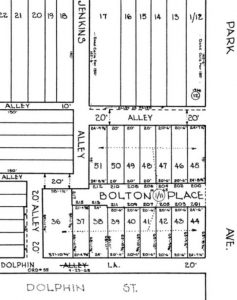
Bolton Place is a group of 16 houses – two connected rows and one freestanding home – opposite the Sutton on the west side of Park Ave., shown on this 1965 plat map:
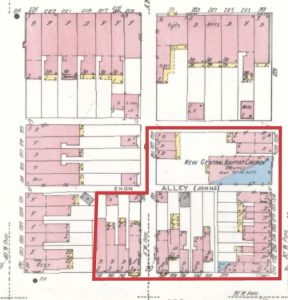
Prior to Bolton Place, this irregular plot of land had been the site of several houses and a church fronting on Park Ave., shown in this embellished excerpt of the 1952 Sanborn map:
The new development’s two rows of houses enclose a courtyard accessible by Park Ave.:
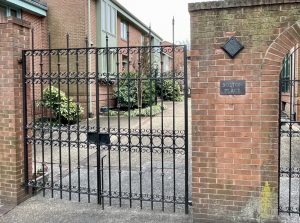
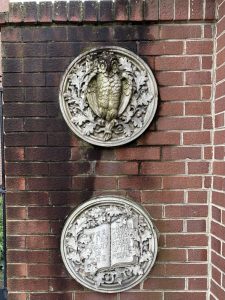
Walter Sondheim Jr. lived in Bolton Place at no. 201, and the freestanding house at the back of the rows was the home of Gerald Johnson, a writer who had previously lived at 1310 Bolton Street. According Frank Shivers, he had these decorative elements installed at the entrance to his new Bolton Hill house:
Bolton Place has a fun origin story stemming from a misunderstanding, recounted in the Sun’s old “Gallimaufry” column in March 1980. The brief anecdote is best taken in full rather than summarized:
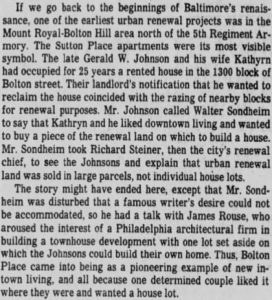
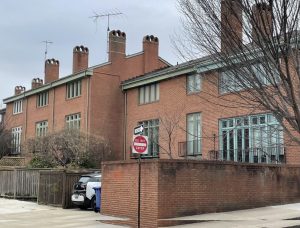
A correction the next month clarified that the Philadelphia firm, Van Arkel & Moss, Inc., was the project’s developer, while the architect was Richard C. Donkervoet, of the Baltimore firm Cochran, Stephenson & Donkervoet. Among the architectural elements helping the modern houses fit their surroundings are bishop cap chimneys:
3. Memorial Apartments – 1966/1967
Now known as Linden Park Apartments, the 286-unit building at 301 W. McMechen was originally known as the Memorial Apartments.
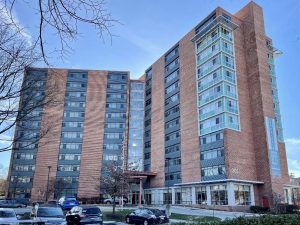
The 12-story tower has a three-pointed star footprint, seen in this Google maps image:
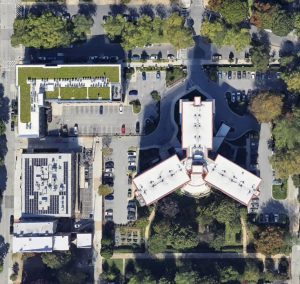
These apartments were created by nearby Memorial Episcopal Church “to prevent deterioration of the neighborhood” and as “a way of helping people,” according to an October 1966 Sun article. The project was specifically for residents at least 62 years old and with income limitations. Construction got underway in November 1965, and at a cost of about $3 million, the project was completed and dedicated in May 1967. (Decades later, in the 2010s, part of the lot was subdivided to create The Jordan, market-rate apartments, discussed at https://macbaltimore.org/linden-park-apartments.)
The building was once home to a restaurant called the Café at Bolton Green, which even merited a mostly positive review from the Sun’s former restaurant critic (with the best aptronym in the business) Elizabeth Large. Of spotty service, she suggested a silver lining: “One of the problems was that this is a neighborhood restaurant, our waitress seemed to know and stopped to chat with practically every other table but ours. That’s the important thing to remember about the Café at Bolton Green, I suppose. It’s a neighborhood restaurant – one I wish I had in my neighborhood, as a matter of fact.”
4. Bolton Square – 1967
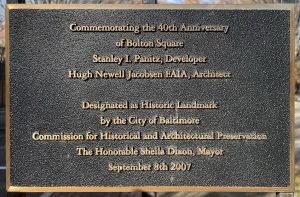
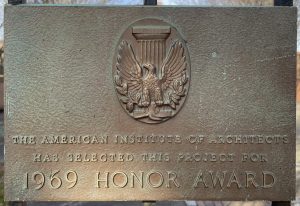
North of W. Lafayette, between Jordan St. and Mason St., sits Bolton Square, a group of 35 houses in staggered rows, designed by architect Hugh Newell Jacobsen and built by Stanley Panitz, clustered around a central green space.
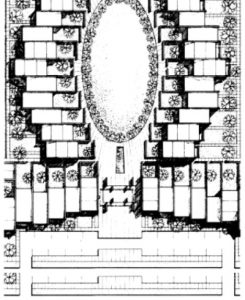
Mr. Panitz himself lived in Bolton Square at 236 W. Lafayette, and among the other early residents was Larry Reich, Director of Planning for Baltimore. The houses were designated a historic landmark by Baltimore City in 2007 and have won multiple design awards.
5. Lafayette Close – 1968
The plan had been for all the modern houses south of Lafayette Ave., along what had been Linden Ave., to be built at once, but those plans took a left turn. A February 1965 Sun article announced that the developer, called “Redevelopers of Baltimore,” would be building 40 new townhouses named “Lafayette Close” in the block south of Lafayette, north of Lanvale, and between Mason and Jordan streets. The total number of houses planned increased with time.
Ground was broken for the first seven red-roofed houses on the south side of W. Lafayette Ave. in August 1966 (i.e., 243-255 W. Lafayette Ave.). But a May 1966 Sun article had said the commitment to build the whole project at once had been “eased,” scaled back to building the project “in five stages.” It was reported this was mandated by the mortgage lender: “If the seven houses built in the first stage should not sell and Redevelopers was foreclosed, the bank’s liability would be less than if it were saddled with 43 unsalable houses.”
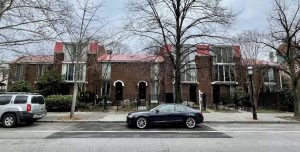
Richard Stauffer was identified in articles as the architect of the project. One wonders if his red roofs were a visual reference to the roofs on 204 W. Lanvale St. – the nursery school (and oldest existing Bolton Hill house) – and to 211 W. Lanvale St. At any rate, once these were built, the rest of the project stalled for several years.
6. Park Purchase I / Atrium – 1975
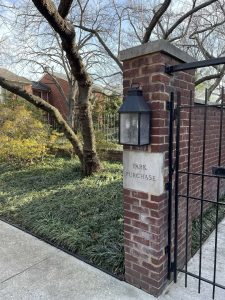
In the image below, this edited excerpt of the plat for the area south of Lafayette shows in green the seven houses previously built as Lafayette Close, and in orange are the next 29 houses – the first phase of the joint venture between Park Purchase Corp. and Atrium Inc. Morton Sarubin, who had developed the Beethoven Apartments, headed up Atrium, while Arthur L.S. Waxter Sr. led Park Purchase (hence his name now appears on a lane down near Dolphin St.) In the image, the bottom two rows of houses on Lanvale are just the top half of what’s commonly called the “Lion Park” today. The lower half of those weren’t built until later.
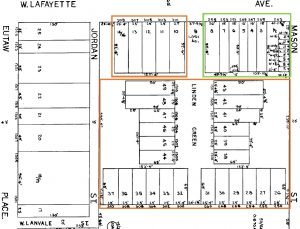
Plans for these 29 additional houses were approved by the city in July 1973 (over some objections from the Mt. Royal Improvement Association, related to parking and other elements). A May 1974 article, once construction was underway, noted the new architects involved were Peter D. Paul Associates. Of the courtyard in the center of the block, the article explained: “Park Purchase will include an elaborate landscape plan for the townhouses, featuring a park and plaza. The plaza will have a garden pool and fountain, with a wooden footbridge over the pool.”
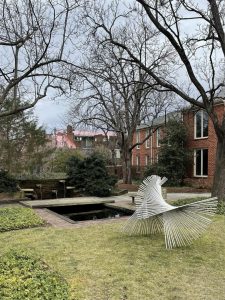
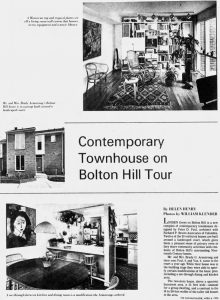
The house at 1307 Linden Green was profiled in an April 4, 1976 Sun article.
7. Bolton North – 1977
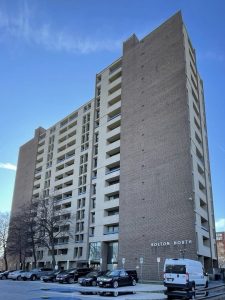
Bolton Hill got its third new apartment building in 1977, the Bolton North high-rise on Mt. Royal between McMechen Street and North Avenue. On this site there once stood several houses and the Mt. Royal Ave. Methodist Protestant Church.
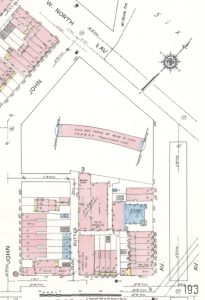
In April 1976 the Sun reported that the 15-story, 208-unit building would be constructed here “for low and moderate income renters.”
8. Park Purchase II – 1979
A June 1978 advertisement in the Sun announced that the then-final phase of Park Purchase was under construction, and an accompanying photo shows us that by then, the lions had been installed. These are the 15 modern townhouses on the south side of Lanvale St. between Mason Street and Eutaw Place.
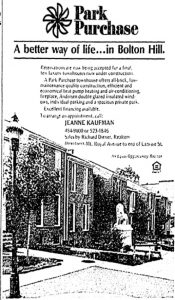
The blurry text of the advertisement begins, “Reservations are now being accepted for a final few luxury townhouses under construction.”
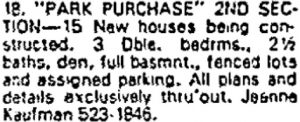
Another ad in September of that year described, “‘PARK PURCHASE’” 2ND SECTION—15 New houses being constructed. 3 Dble. Bedrms., 2½ baths, den, full basmnt., fenced lots and assigned parking.”
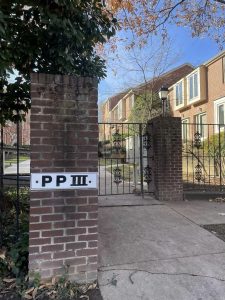
9. Park Purchase III – 1985
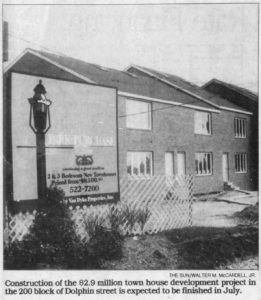
And finally, for the series of Park Purchase phased-in construction, down by Dolphin Street we have Park Purchase III, 27 houses outlined in red in this excerpt from their plat:
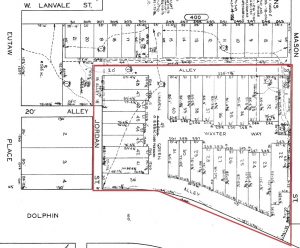
A March 1985 article in the Sun reported that the architects for this phase were Building Technologies, Inc., of Columbia, Maryland.
10. Spicer’s Run – 1998
At the northwest corner of Bolton Hill, in a large triangular lot bounded by Eutaw Place, Robert Street, Bolton Street, and North Avenue, once stood a good many houses, outlined in red on this excerpt from the 1952 Sanborn maps:
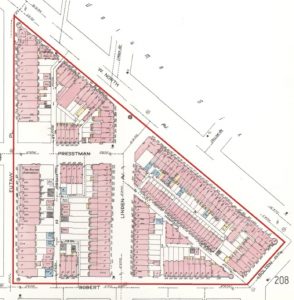
Subsequently, on this land stood a collection of three- and four-story apartment buildings called Eutaw Gardens, for low-income residents. Conditions at Eutaw Gardens became so bad, the U.S. Department of Housing & Urban Development, under then-Secretary Andrew M. Cuomo, took control of the site, relocated the residents, and sold the entire lot to Baltimore City for $1, according to a June 1997 Sun article by Ed Gunts.
A duo of young developers, Wendy Blair and Derek McDaniels, led the creation of a new development of 86 market-rate single-family homes there called Spicer’s Run, named after a stream that once ran through the area. Architectural historian Charles Belfoure wrote for the Sun in December 1998 that the architect for this project was the late Don Taylor and his firm D.W. Taylor Associates in Ellicott City. Their house designs did not merely suggest, nod to, or reference historic details; they liberally borrowed aspects from the older houses, to great success:
“We drove up and down the neighborhood looking at the detailing of the houses,” Taylor said. “We couldn’t duplicate everything we saw, but we could include some important historic design features.” The tall, narrow proportions of the windows of the Eutaw Place houses were incorporated in the facades of Spicer’s Run. … Other design elements include a cornice that matches the scale and detailing of the historic houses. But the most prominent feature is the arched door surrounds on many of the new houses.
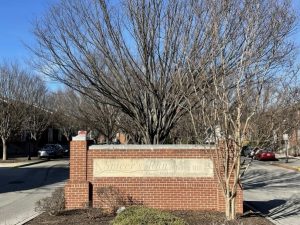
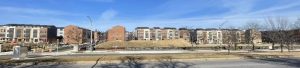
Isn’t it ironic, after building and razing and rebuilding, that we return so often to townhouses? Or as we call them here, of course, row houses. Look across North Avenue at the new Reservoir Square development, and what do we find progressing? Yet another new row house development.
Thank you for feedback, corrections, and suggestions from Doug Kelso, Barbara C. White, Merry Rogers, Dino Sangiamo, Charlie Duff, Monty Howard and Stephen Howard, Richard Stein, and Lynn Cripps. A complete set of the 1952 Sanborn maps with red outlining of razed properties can be found at this link. A survey of MICA’s dorms is left to be covered in another article to come. If you would like to write it, please email history@boltonhillmd.org.
 Download PDF