
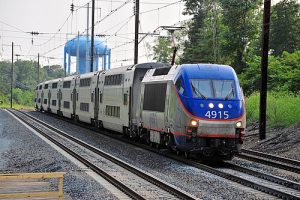
Even prior to the COVID pandemic, Bolton Hill has had a high number of work-from-home resident professionals, especially in government. But greater demands for regular office appearances are threatening that comfortable arrangement.
President Trump’s executive order upon taking office last January, though misleading in its statement of the situation he inherited, has led to many government employees heading to the MARC train or, worse, driving toward I-95. Citing Trump’s example, many private employers began demanding at least hybrid arrangements, with most employees at their offices. A recent Wall Street Journal assessment noted that, for job hunters, “Landing a remote job in 2026 is only slightly less competitive than cracking an NBA roster.”
“We appear to be reaching remote-work equilibrium, after years of conflicting trends and predictions,” said the Journal. “The share of open jobs listed as remote on the career site Indeed has held steady between 8% and 8.6% for the past six months. That’s roughly triple what the rate was in 2019 but markedly less than in 2022.”
So, what has the impact been here in the neighborhood? Hard to know with scientific accuracy, but those who are talking say it’s not great.
Jeffrey Hill came to Bolton Hill in 1999. From then until the pandemic hit in March 2020, he commuted about an hour by MARC train to a government office in Washington next to Union Station. “I generally worked from home (and other locations) from March 2020 until April 2025, first due to the pandemic and then due to the closure of our office building for a move.
“Since last April, I’ve been braving the horrible traffic involved with driving to Suitland each day (to the new Bureau of Labor Statistics headquarters). That’s why I leave my house at 4:50 am and arrive at the office just before 6 am. I generally try to leave the office at 2:30 pm, but sometimes I do stay later. I’m about to put my house on the market. I’ll move closer to Suitland until I likely retire at the end of the year.”
John Butz has a somewhat happier situation as a Navy civilian engineer since 2015. “My reality is I spend most of workday on the phone with contractors and other Navy people, scattered around the country. Before the pandemic he commuted 2-3 days a week and mostly was able to telework the rest of the time, in accordance with Navy policy at the time.
“When the pandemic hit we all transitioned to full remote work with relative ease, as our teams are naturally dispersed geographically given the nature of the work. Since the executive order I try to work four 10-hour days, still teleworking with permission in accordance with current Navy policy. That tends to work out to 1-2 days a month as things arise.” Also with permission, he does administrative work on the train, part of his four-hour round-trip commute on the MARC and Metro. “Otherwise, it would be unsustainable with a family that I didn’t have when I started. Our management is pretty chill.”
Elizabeth Peters had an office to go to in New Carrollton before the pandemic, a dependable one-hour each-way trip. She works for an educational technology company and supervises teams across the country and in India and South Africa, starting Zoom meetings as early as 7:30 in the morning. Meanwhile her company re-located to Northern Virginia.
“My company now has an in-office policy for all new hires or those within a certain radius – fortunately 35 miles, where I am 48 miles.” As a volunteer editor of The Bulletin, she helps package this newsletter (this month from Cape Town). “I value being remote for the flexibility, but the biggest thing that surprised me when I was no longer going in regularly was not having variety in the food I eat day to day!”
–Bill Hamilton
 Download PDF