
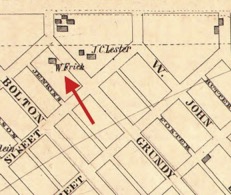
If you spend time around Park Avenue north of Mosher Street, odds are good that you’re on land once owned by Judge William Frick. His country estate is labeled on the 1851 Plan of the city of Baltimore, situated near the top of what was then called Grundy Street (later Park Avenue), where the Friends School condos are now.
And although Judge Frick was born in Baltimore more than two centuries ago in 1790, the Maryland Center for History and Culture has photographs of him, including this undated portrait.
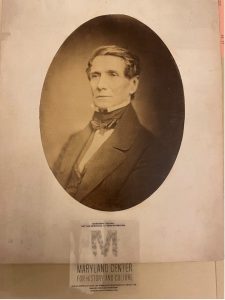
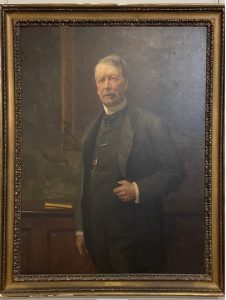
The Judge’s full biography far exceeds the scope of this piece. He was a significant figure in Baltimore history. His biographical sketch includes his volunteering in the War of 1812; that he was the collector of the Port of Baltimore, a state senator, a judge on Maryland’s highest court and the first judge elected to the Superior Court of Baltimore City.
His papers in the Peabody Archives at the Arthur Friedheim Library include correspondence with people like Washington Irving and James Fennimore Cooper, and more everyday notes from people like his neighbors, the Tiffanys. He died in 1855 and is buried in Green Mount Cemetery just northwest of the large mausoleum.
An 1857 probate listing of Judge Frick’s estate calculated a value of $3,558.87 (about $132,000 today) just for the assets at “the Country Dwelling,” which included in the last line in the inventory, “1 Negro Girl named Susan about 16 years old a slave for life,” valuing her at $450. In one of the final paragraphs of his 1854 will Judge Frick had written, “To my Slaves, I give their freedom as they respectively arrive at the age of twenty eight years with a bequest of one hundred dollars to be paid to each of them upon the occasion, by my wife, or such child as may at the time have such Slave in their service.”
Possessing so much potentially valuable land, Judge Frick’s heirs set about on a familiar real estate development plan. In their 1999 book The Baltimore Rowhouse, authors Mary Ellen Hayward and Charles Belfoure describe a strategy whereby developers would donate a centrally located tract to the city as park land in perpetuity, because that helped sell the new houses to be built around the park.
The developers “recognized that the wealthy wanted rural-like scenery but with urban amenities,” and the park enhanced the value of the lots facing it and elevated the value of those in the surrounding neighborhood. Judge Frick’s oldest son, William Frederick Frick (himself a prominent attorney), led the heirs in this strategy.
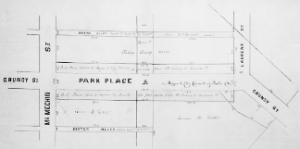
In July 1860, on condition that the city receive a deed for the land, an ordinance was passed “to close Grundy street, between McMechen and Laurens streets, and Foster alley from McMechen to Wilson streets, and Jenkins alley from McMechen to Laurens streets, as laid down upon the plat of the City.” Under that ordinance, the area was “to be called Park Place, and to be kept and preserved as a public park forever.” The ordinance provided that the median would be enclosed “with a good and substantial iron railing similar to that at Mount Vernon Place,” but not until “at least one-half of the aggregate front feet of both fronts on such square or squares, are improved with good and substantial houses.”
In a probate “Account of Sales” on July 27, 1860, William Frederick Frick’s sale of the land to the city for $1 was ratified, creating Park Place.
The Mayor of Baltimore was authorized in May 1875 to appoint three commissioners who would be responsible for maintaining Park Place – without compensation. In June the city allotted $1,500 “for the kerbing of Park Place.” Also in June, park commissioners were appointed: Garrett B. Davids, Frank Frick (one of Judge Frick’s other sons, apparently), and D.L. Chamberlain.
A Baltimore Sun article in June 1878 described some recent Baltimore improvements, beginning with Eutaw Place, then:
Park Place, though a younger sister, is rising in importance, and already a fine block of marble buildings, extending from McMechin [sic] street, has been erected by the enterprising builders Walsh & Sons. … Park Place has as yet enjoyed to a limited extent the fostering care of the city, but when properly improved will be early sought for as a suitable neighborhood for the erection of private residences.
More was needed from the city for the parks to thrive: $800 was allocated in May of 1875 and another $2,500 in May 1878 for improvements. In May 1880, Baltimore passed an ordinance “to prohibit the driving of cattle, hogs or sheep on Laurens, McMechen, or Wilson streets, between Linden avenue and Park avenue or John street.”
A Sun article in July 1881 noted that, by then, the lower Park Place median park had “a fountain, rows of shade trees, and a fine growth of grass and is surrounded by a dressed granite curb.” It said that around the upper park, “a curb is being set, trees planted and walks laid out.” The commissioners still included Frank Frick and Garrett B. Davids, and now Basil Wagner, of 1610 Park Ave. (which previously had been numbered 430 Park Ave.).
The next year resources were made available to install proper drainage for the fountain. Later, in 1896, the “Superintendent of Lamps” for the city reported, “The 16 gas-lamps situated on Park Place Square that were changed to the Welsbach lights are a decided improvement in illuminating the squares over the ordinary gas lamps.”
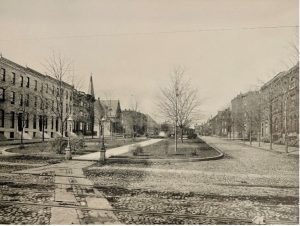
Sometime in the 1880s eight large vases, also referred to as urns, were installed. Initially they were near the center of each median park where the fountains are, but today they are at each corner. The 2010 book Bolton Hill: Classic Baltimore Neighborhood by Frank Shivers, shows the vases’ original locations in the park opposite Friends School.
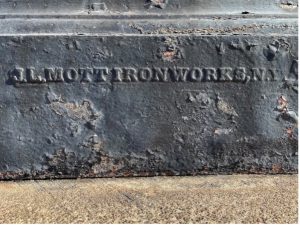
At the base of some of these today can still be read “J.L. Mott Iron Works, N.Y.,” the manufacturing firm perhaps better known later for their plumbing hardware. (An apocryphal tale holds that Mott sold Marcel Duchamp the piece he used for his “Fountain” ready-made work.)
Our vases most closely resemble (but not exactly) Mott’s “Renaissance” model, found in an 1875 catalog available online.
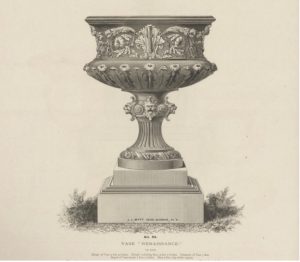
The most notable differences between that model and ours are the leonine faces around the stem underneath the bowl. Interestingly, around that height, the stems of our vases have holes where such elements could have been affixed, possibly indicating these were manufactured to be customizable and ours came without those elements.
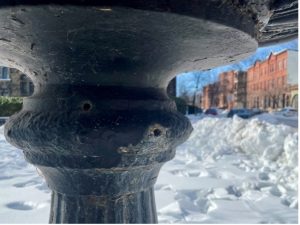
Mischief ensued. A Nov. 4, 1889, Sun article reported, “Complaint was made at the mayor’s office by one of the commissioners of Park Place that boys had thrown the flower vases from their pedestals in that square. The matter was referred to Marshal Frey.” Over the years this wasn’t unheard of. A September 1945 Sun article about vandalism in Baltimore cemeteries also mentioned, “Ornamental iron vases in the Park avenue squares … have been overturned repeatedly.”
After many decades in place, the fountains in Park Place saw neglect as well. The large original cast-iron fountains at the center of each basin were removed at some point, and in a 1963 letter to the editor in the Sun, Mt. Royal Improvement Association president Robert Thieblot lamented that the Park Avenue fountains (among others) were then “dry … filled with earth and planted over.” A later Sun article describes the efforts of Marian (Lewis) Baker, an active garden club member at 1607 Park Ave., to persuade the city to improve the parks. “It just takes constant vigilance,” she said of her persistent advocacy with city agencies.
In April 1968, a Sun article profiled attorney Leonard Kerpelman (who argued Abington School District v. Schempp, the school prayer case in the Supreme Court, in 1963), and his enjoyment of the recently “refurbished” fountains on Park Avenue. A June article in the Sun that year mentioned the refurbishment cost of nearly $50,000. The reception to these improvements was mixed. An anonymized column from November 23, 1975, in the Sun panned the results:
When I first lived in the 1600 block of Park avenue … the centers of those parks contained overgrown planters. Then … the parks were repaved, the planters removed and the fountains reopened – though I can’t believe the fountains there now resemble the original ones. Each consists of a big, lumpy basin in the center of which a trumpet-like spray of water rises around a single jet that shoots straight up. Maybe that doesn’t sound bad, but the trumpet-like spray is so dinky in the middle of its great basin … that frankly the fountains look ridiculous to me. Among the fountains I am acquainted with in Baltimore, those are the worst.
An alternate view from today’s perspective is that the 1960s renovations successfully brought this useful public space back from decline after World War II – digging out, modernizing and providing lovely nighttime lighting for the well-laid out fountains, and providing the more neighborhood-friendly park bench seating and landscape chains around each fountain quadrant.
–Kevin Cross
 Download PDF