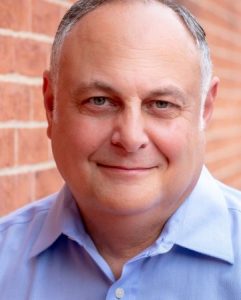
 Passing by the 1400 block of Bolton Hill, you just might catch Leo Wanenchak playing the piano by the front window of his home.
Wanenchak, an accomplished pianist, organist, composer and music teacher, is the Associate Conductor of the Baltimore Choral Arts Society, Director of the Larks, a women’s vocal group, and Musical Director of the ParkinSonics choral group sponsored by the Johns Hopkins Center for Music and Medicine.
Wanenchak’s foundation for his musical activities is his fascination with how people learn, how music affects the brain, and how music comes together. He quotes Renee Fleming, who said, “Music affects every mapped area of the brain”, and he goes on to observe that no other activity engages the brain as fully as music.
Wanenchak grew up in Philadelphia, in a musical family. His father’s instrument was the accordion, and he played in a band that performed in the popular 20th century nightclub Palumbo’s, near the Italian Market. His father gave up music to better support his family, but Wanenchak remembers that popular music was always playing on his father’s Fisher console record player at home. The first instrument that Wanenchak learned to play was his father’s accordion.
By sixth grade Wanenchak joined the Catholic Cathedral boys’ choir, where he began to learn music theory. In high school, he became enamored with the organ and taught himself to play, later accompanying the choir at masses. In high school he also began piano lessons, and in 1975, he auditioned for the Peabody Conservatory in Baltimore. Wanenchak’s father wanted him to become an accountant; he was good at math, but Wanenchak was set on a musical career. Loosely quoting Leonard Bernstein, he said, “I do it because I can’t not do it”.
Wanenchak’s teaching and mentoring career began when he was a student at Peabody. A professor tapped him to teach at The Walden School, a summer music program for high school students in New England, after which he began teaching at the Peabody Preparatory School. Through these activities, he discovered his passion for how students learn and how teaching techniques can impact learning. He is currently a Teaching Artist with Avivo, from the founding generation of The Walden School, where the school says he “brings a dynamic energy to his teaching that is inspiring and truly engaging. With his unique expertise, he has contributed countless concrete and inventive training methods to the realm of choral education” He brings this same expertise to his private studio for children and adults, many of whom live in Bolton Hill.
For the past 25 years Wanenchak has been the Associate Conductor with the Baltimore Choral Arts Society and the Music Director for the Larks, a community-centered women’s chorus affiliated with the Junior League of Baltimore.
Wanenchak prepares the Choral Arts chorus for concerts and often accompanies it on organ or piano during performances. For the Larks, he creates the repertoire and directs its performances to underserved communities throughout Greater Baltimore. He has recruited a number of women from Bolton Hill to join both groups.
Around 2020, a connection from the Larks led to Wanenchek’s involvement with ParkinSonics, a Johns Hopkins University Center for Music and Medicine research project evaluating whether group singing improved the quality of life for patients with Parkinson’s disease and affected disease progression. Working with a speech pathologist, Wanenchek provided formal music training to Parkinson’s patients, starting with physical warmups, breathing exercises, rhythm exercises, music theory, and diction. The chorus performed old standards from Broadway musicals, folk music, and hymns. The research project concluded that ParkinSonics had a positive effect on Parkinson’s patients, improving their voice strength and clarity. The program continues with weekly group singing and exercises. Wanenchek feels that the community that has formed is as important as the music program.
Wanenchek moved to the 1400 block of Bolton Street in 1993 and lives there with his husband, David Ruschke. Wanenchek believes that music “keeps our brain connections going” and he continues to connect Bolton Hill neighbors with music through his lessons and recruiting singers to join vocal ensembles and choruses.
–Sallye Perrin
 Download PDF