What do you really know about where we live, beyond Bolton Hill’s historical roots, its charming architecture and your friendly neighbors?
A deep dive into available census and other gathered data about the neighborhood offers several surprises for those who see us strictly as a neighborhood of grand old three-story 19th century red brick rowhouses with white marble steps and high ceilings.
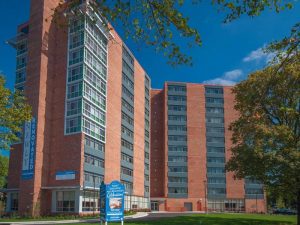
- Apartments in nine high-rise complexes account for about half of the neighborhood’s roughly 3,000 residences.
- Although Bolton Hill residents are more highly educated than most Baltimore neighborhoods, our median household income is actually lower than citywide figures.
- And there are conflicting notions of where Bolton Hill’s borders begin and end.
In fact, there are three different configurations of Bolton Hill: the traditional one embraced by BHCA, the current “official” one recognized by the city and state, and the one used by The Statistical Atlas of the United States in reporting federal government census data. Recent analyses of our neighborhood by BHCA’s Membership and Safety and Security Committees have provided interesting information about all three configurations.
The BHCA by-laws contain the following boundaries of Bolton Hill, carried over from the association’s former life as the Mount Royal Improvement Association:
“on the south to and including the properties on the south side of Dolphin Street, on the east to and including the properties facing the east side of Mount Royal Avenue, on the north through the median strip of North Avenue, and on the west, to and including the properties fronting on the west side of Eutaw Place.”
As a result of substantial rerouting of Dolphin Street during 1960s urban renewal, however, it no longer intersects Mount Royal. Traditional Bolton Hill’s current borders are now connected by Howard Street in the City of Baltimore’s official maps, which are also used by the State of Maryland in its official property records. The official maps of Baltimore divide neighborhoods in the middle of streets, while the traditional definition includes both sides of Dolphin, Eutaw and Mount Royal.
Traditional Bolton Hill has 26 named passageways: 18 have both at least one separate area for vehicular traffic and at least one separate area for pedestrian traffic along some part of its length. The others accommodate vehicles without a separate area for pedestrians or do not accommodate vehicles at all. Because Bolton Hill developed with additional building entrances for deliveries/pickups, there are also a large number of unnamed passageways of various types. For example, one can walk from Mason to Bolton on Dolphin, on Lanvale, or on an unnamed narrow alley between them.
State property records list 1,058 registered buildings on the official configuration of Bolton Hill, with 809 classified as residential, 96 as residential condominiums, and 15 as apartments with four or more units. Of these, 616 of these are owner-occupied, and 52 are mixed occupancy (owner plus rental). In the traditional configuration, there are also 68 buildings on the west side of Eutaw, including two of the Pedestal Gardens Apartments; multiple MICA buildings, including its Gateway dormitory on the northwest side of Mount Royal, and a high-rise and a medium-size apartment building on the far side of Dolphin.
According to the Statistical Atlas, Bolton Hill (the current official configuration plus the east side of Mount Royal) has 4,974 residents living in 2,954 households. MICA students are included in this number, and MICA has 1000 student beds. While 6.9 percent of Bolton Hill residents are below the age of 18, 23.8 percent are 65 or above.
Our racial percentages are 48 percent White, 34 percent Black, 7.1 percent Hispanic, 6 percent Asian and 3.9 percent mixed, while 59.5 percent of us who are 25 or older have college and/or graduate degrees. Citizenship percentages are 84.8 percent US citizens by birth, 8.1 percent naturalized, and 7.1 percent not citizens. Our median household income is $47,900, while the median household income in Baltimore City is approximately $62,177 based on 2020–2024 census data. Presumably that disparity reflects the large number of student households and older residents of subsidized senior housing.
About half of our households appear to live in approximately 1,600 high-rise apartment building units. They include Beethoven Apartments, 63; Bolton House, 260; Bolton North Apartments, 209; Hampton Court Apartments, 28; Jordan Apartments, 62; Linden Park Apartments, 266; Marlborough Apartments, 227; Pedestal Gardens, 205; and Re/New Mt Vernon, 294.
–Don Feuerstein is a member of BHCA’s board
 Download PDF