
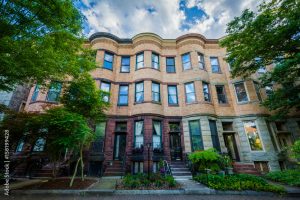
BHCA opposes the bill before the city council that would end restrictive zoning and allow property owners as a matter of right to divide single houses into up to four units as a matter of right. There are voices in the neighborhood that disagree.
There’s been much discussion in the BHCA about the Housing Options and Opportunities Act (SB 25-0066), under consideration by the city council. The bill would effectively end single-family zoning across Baltimore, allowing duplexes and other multi-family homes everywhere in Baltimore. While the full impact of this change is still unknown, I believe the bill would help address the significant quality-housing shortage we have in Baltimore by removing restrictions that have prevented densification and construction of new housing in the places where people want to live.
We need to come to terms with the fact that, like many other cities across the country, Baltimore is dealing with a housing shortage. It may be harder to identify where and how due to the disparities in housing stock across Baltimore, but it is here and it is real. We have significantly fewer quality housing options in the places where people want to live, despite there being meaningful demand to live in Baltimore, particularly near public transit in communities like Bolton Hill.
I personally know families who started their time in Bolton Hill as renters but were unable to find affordable housing here for them to stay on as their family grew. These are families who are members of Bolton Swim and Tennis Club and who send their children to Bolton Hill Nursery, and likely wanted to stay. If there were more and different housing opportunities, I believe they would have. Now they are invested in other neighborhoods and other communities instead of building our own.
Imagine the opportunities and community strength that could be entrenched in Bolton Hill if we were able to meet more peoples’ needs with more varieties of housing. These new zoning laws provide for that, with the easier creation of new (rentable) garden apartments that allow homeowners to afford entry prices for expensive row homes. Or similarly, these zoning laws allow new housing units for in-law suites to accommodate bigger, extended families. Similar housing models have worked in DC, where garden apartments, multi-unit additions, and rentable in-law suites are so common that they effectively subsidize homeownership in a time of rising home prices and high interest rates. Such accommodations are almost unheard of here in Baltimore because creating them was more difficult and in many cases illegal; that would change.
At the same time, I understand that large-scale change to the zoning laws brings unforeseen consequences and the fear of negligent landlords and developers buying up housing stock to make new apartments. This is unjustified for two reasons. First, the housing market in our neighborhood is robust and demand is high for existing stock, so competition to convert existing housing into four or more units by developers seems unlikely when other, cheaper conversions would be available nearby, such as in empty lots or areas that have seen less development where the value proposition is higher. And second, there is little evidence from our existing renter and landlord community that they would be absent or out of touch with the neighborhood. Of course, we can’t predict the future, and that is why the legislation offers retrospective reviews as the full effect becomes known.
Putting fear aside, I honestly believe that our community is strong already and will only get stronger if we are open to more people living in Bolton Hill, the neighboring communities, and throughout Baltimore. Increasing the kinds of housing availability makes that possible, and we should not lose sight of the original intention of single-family zoning laws. They were explicitly designed to exclude and to preserve the racial and social demographics of neighborhoods. We should be ready to move beyond such history and not inadvertently preserve that particular character of this neighborhood and others. Instead, we should seek a brighter future with more housing options for more people, in Baltimore and in Bolton Hill.
–Adam Aviv is a professor of computer science at the George Washington University. He and his family are Bolton Hill residents.
 Download PDF