
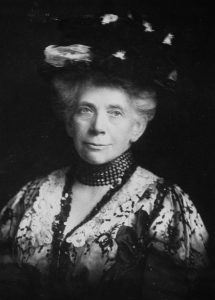
This is the first in an occasional series about the women and men who merited a Blue Plaque marker (there are 49) posted on Bolton Hill’s row houses. The author, Justin C. McArthur, lives on Bolton Street and is a professor of neurology at Johns Hopkins University and neurologist-in chief at Johns Hopkins Hospital.
Chrstine Ladd-Franklin was an important scientist who, with her husband, lived at 1507 Park Avenue in Bolton Hill from about 1904 to 1909. She is best known for developing and promulgating her own theory of color blindness. Despite successfully completing graduate work at Johns Hopkins, she was prevented from receiving her doctoral degree for 44 years.
I select her as one example of how women scientists and physician-scientists have been marginalized by their male “colleagues,” yet nevertheless have contributed to scientific advancements and our understanding of health and disease.
Christine Ladd was born on Dec. 1, 1847, in Connecticut, to a merchant, Eliphalet, and Augusta Ladd. During her early childhood, she lived with her parents and younger brother Henry in New York. Augusta and a sister were staunch supporters of suffrage, and her parents encouraged Christine’s desire for higher education. Her father enrolled her in a program at the co-educational Wilbraham Wesley Academy, where she took courses with male classmates. She then matriculated into Vassar College but left because of financial constraints.
Ladd worked as a school teacher until her aunt paid for her to re-enroll in Vassar, where she earned an A.B. degree in 1869. At Vassar, Ladd began working under the mentorship of astronomer Maria Mitchell, who discovered a new comet in 1847. Under Mitchell’s guidance, Ladd developed a love for physics and concern for the injustice she observed in the oppression of the female sex. In a journal entry while at Vassar College she describes her disappointment with the views in society about and among women, stating,
“I so despise the idea that women are not as competent to take care of themselves as men, that they cannot decide for themselves when to go to bed and when to get up, how much exercise to take, how much to pray and go to church. Still my greatest objection is to the class of girls who come here and to the social and political atmosphere of the place…I know of but one girl who declares herself for the rights of women” (September 22, 1866).
After graduating from Vassar, Ladd taught science and mathematics at the secondary level for nine years, and also submitted mathematical problems and solutions to the Educational Times of London. In 1878 she applied for graduate studies at Johns Hopkins University (JHU) as “C. Ladd” and was offered a position without the institution realizing that she was a woman. (JHU did not officially admit women graduate students until 1907 and women undergraduates until 1970.)
Once aware that C. Ladd was woman, they tried to revoke the offer, but mathematics Professor James Sylvester took her on as a student. She studied at Johns Hopkins University for three years, but the trustees did not allow her name to be listed with other fellows, for fear of setting a precedent. She performed at an exceptional level and was awarded a stipend; however, she was not awarded her doctoral degree (in mathematics and logic) until 44 years after she graduated, in 1926.
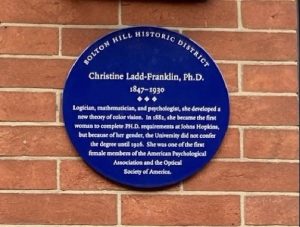 Christine met her husband Fabian Franklin at JHU where he was a faculty member in mathematics. They married in 1882 and the following summer Christine had a son who died shortly after birth. The next summer a daughter Margaret was born, and she went on to become a prominent member in the suffrage movement. The house where family lived on Park Avenue bears a marker to her accomplishments.
Ladd-Franklin was among the first women to have a published paper in the Analyst. She completed publications based on visual processes and logic, however. In 1893, she was denied a teaching position at JHU. Wellesley college psychologist Laurel Furumoto, in her work discussing the sociopolitical environment of the time, notes that Ladd’s “inability to secure a regular academic position was a predictable consequence, in that time period, of her decision to marry.” Eleven years later, in 1904, she was at last given permission to teach one class per year. For the next five years her position at JHU had to be approved and renewed on a yearly basis. She moved away from Baltimore when her husband moved to Columbia University in 1909. She never held a regular academic appointment; however, she occasionally offered courses on color vision and logic at Columbia University in the 1920s.
She carried out experimental work on vision that added to the existing theories of color vision. Ladd-Franklin developed her own theory of color vision and in 1929 published Color and Color Theories, largely based on evolutionary principles. Ladd-Franklin noted that: “some animals are color blind and assumed that achromatic vision appeared first in evolution and color vision came later.” Ladd-Franklin concluded that color vision evolved in three stages: achromatic vision (black and white), blue-yellow sensitivity and red-green sensitivity.
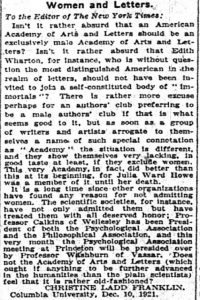 In addition to her professional life, she continued to be active in the suffrage movement and her treatment at Johns Hopkins probably continued to affect her for her whole life. This is well illustrated in this letter (at left) to the New York Times in 1921 protesting the exclusion of women from professional societies. She died on March 5, 1930 in New York, New York.
Obstacles to women as scientists
In the decades before the twentieth century, science was largely the province of “gifted amateurs” supported by patrons or personal wealth. From 1900 on, however, science became increasingly professionalized, and this amplified the disadvantage for women who aspired to scientific work. Furumoto has articulated how Ladd-Franklin overcame the societal and professional barriers to a career as a scientist.1,2 These include a mother and maternal aunts who were women’s rights advocates; a supportive father; a role model and mentor in the Vassar astronomer and suffragette Maria Mitchell; and marriage to a fellow academic, Fabian Franklin, who encouraged and supported her work. Despite progress in the entry of women into science and biomedicine in the past 50 years, the USA failed to ratify the Equal Rights Amendment (ERA) that was proposed in the 1960s as an amendment to the Constitution designed to guarantee equal legal rights for all American citizens regardless of sex.
Leaders in academia too often contributed to maintaining the status quo and not encouraging the advancement of women scientists. A powerful narrative describing entrenched discrimination that stifled women scientists comes from the Massachusetts Institute of Technology. In the 1980s 16 women faculty banded together to fight for recognition within their academic community. Their struggle, and ultimately their success, is documented in Kate Zernike’s excellent book “The Exceptions.”3
There are still too many examples of how women scientists – and those under-represented in science – have not benefited from the advantages that men have enjoyed. These are well documented in the lower rates of NIH funding for women scientists, persistent differences in compensation between women and men doing the same work, and even in a delay in academic promotion for women compared to men.4 Awards and academic prizes are still dominated by men. For example the most recent Nobel laureate, Dr. Kariko, is only the 13th woman to be awarded the Nobel prize in Physiology and Medicine of 227 Nobel laureates.
Of course, there have been societal efforts to address inequality and achieve equity for women and individuals from backgrounds that are under-represented in science. The NIH and other funding agencies have established pathways to encourage women scientists. One prominent example that was created by the NIH’s Office of Research on Women’s Health (ORWH) called the Building Interdisciplinary Research Careers in Women’s Health (BIRCWH). It is a mentored career-development program designed to connect junior faculty, known as BIRCWH Scholars, to senior faculty with shared interest in women’s health and sex differences research. Since the program was created in 2000, more than 750 junior faculty have been part of the BIRCWH career development training.
Despite this progress, women still lag men in the number of publications, particularly at the junior faculty rank. One study showed that male assistant professors had, on average, twice the number of publications compared to their female peers.5 Women continue to be under-represented among senior faculty ranks and leadership positions. To address this gap, many institutions and professional societies are now intentional at considering women and under-represented minorities for leadership positions, selection as speakers, or award recipients. Professional societies such as the American Neurological Association and the National Academy of Medicine (NAM) have been successful at encouraging and promoting participation by women and and under-represented minorities, for, in 2023, 40 percent of newly inducted members into NAM were women.
Unfortunately, since January 2025, there has been an intentional roll-back of initiatives to support women and under-represented minorities under directives from the Trump administration. We should aspire for an environment in academia where women and individuals from an under-represented minority background can thrive and achieve the same levels of academic success. Christine Ladd-Franklin would probably be pleased with the progress in the past four decades; however, I suspect that she’d be greatly concerned with the regression in the past few months and would urge an acceleration of the process.6 In her words, “Isn’t it rather absurd?”
–Justin C. McArthur
The list of all Blue Plaque locations can be found here.
References:
- Furumoto, L. (1994). Christine Ladd-Franklin’s color theory: Strategy for claiming scientific authority? In. Adler, H.E. & Rieber, R.W. (Eds.) Aspects of the history of psychology in America: 1892-1992 (pp. 91-100). New York: The New York Academy of Sciences.
- Furumoto, Laurel (1992). “Joining Separate Spheres: Christine Ladd-Franklin, Woman-Scientist (1847–1930)”. American Psychologist. 47 (2): 175–182. doi:10.1037/0003-066x.47.2.175.
- THE EXCEPTIONS: Nancy Hopkins, MIT, and the Fight for Women in Science, by Kate Zernike. Scribner, 2023.
- Safdar B, Naveed S, Chaudhary AMD, Saboor S, Zeshan M, Khosa F. Gender Disparity in Grants and Awards at the National Institute of Health. Cureus. 2021 Apr 23;13(4):e14644. doi: 10.7759/cureus.14644. PMID: 34046277; PMCID: PMC8141289.
- Pakpoor J, Liu L, Yousem D. A 35-year analysis of sex differences in neurology authorship. Neurology, 2018; 90: 472-175.
- Jensen FE. Editorial: Closing the Sex Divide in the Emerging Field of Neurology. JAMA Neurol 2018; Epub 2018 Apr 2. JAMA Neurology 75(8) DOI:10.1001/jamaneurol.2018.0300
- Christine Ladd-Franklin – Wikipedia: 2023.
