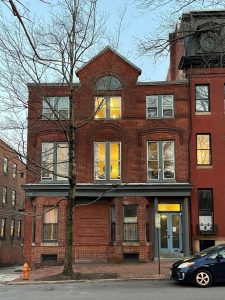
 How many times have we walked past the double-width structure at 151 W. Lanvale St., but not known what accounts for its unique design among Bolton Hill houses? Look at it closely – maybe squint a little – and you might think it resembles a classic, red-brick schoolhouse. And you’d be right.
In June 1873, an advertisement in the Baltimore Sun announced that “Mr. Martin’s School for Boys,” then located on Hamilton Terrace (i.e., Eutaw Street just south of today’s Martin Luther King Jr. Blvd.), was moving to Lanvale Street, near Park avenue, “where there is now in process of erection, a large and handsome Building.” That school would be called The Richland School for Boys and it would include both day and boarding students.
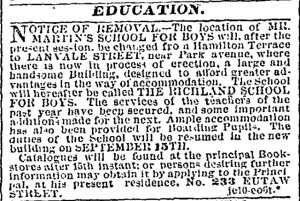
The school did not have a long run on Lanvale. In the summer of 1880, an advertisement listed for sale “School furniture, desks …, blackboards, gymnastic apparatus,” etc.
A grocery store took over the ground floor of the building, and it soon changed hands; as soon as a turnkey store was ready to operate in 1882, it appears, the owner needed to sell it for health reasons: “Owner sick and compelled to leave city.”

(Current no. 151 W. Lanvale was previously numbered 121 W. Lanvale.) Before it got defaced by graffiti recently, a ghost sign on the Brevard Alley side of the building read “Myers & Co. Groceries & Provisions,” and advertised “Harter’s A. No. 1 Flour,” to the right of what appears to have been a basement-level doorway, which now looks like a window. A panel on the sidewalk appears to cover stairs that would have led to the lower doorway.
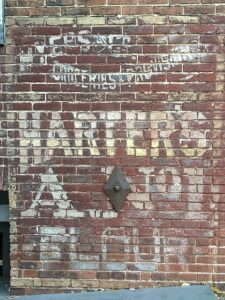
2017 photo by Dr. John C. McLucas
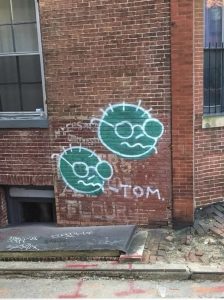
2019 photo by neighbor Kelly Knock.
Meanwhile in 1881 above the store, parts of the property were being advertised for rent as a handsome hall “… with three Rooms attached, suitable for Religious Worship, Societies, School, &c.”

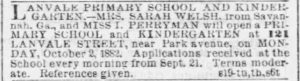
Part of the building was rented out as another school later in 1882, this time a primary school and kindergarten operated by “Mrs. Sarah Welsh, from Savannah, Ga., and Miss I. Perryman.”
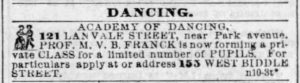
And another part of the building functioned as an “Academy of Dancing,” run by Prof. M.V.B. Franck.
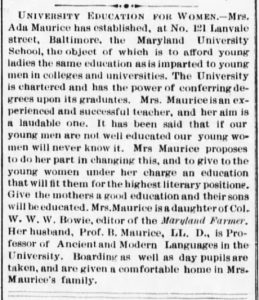
The Aegis, a Bel Air newspaper, reported a promising development planned in 1883. A school was planned by Ada Bowie Maurice, “to afford young ladies the same education as is imparted to young men in college and universities.” Little else is found about this venture, and if it failed to launch, maybe that had to do with the nearby proximity of another school called Baltimore Female College. Ms. Maurice taught at that school soon after this announcement, and later sued them for unpaid wages and won $175 (about $6,000 today).
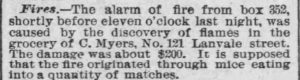
The building suffered at least two significant fires in the 1880s, first in one of its school iterations. A January 1883 Sun article reported a fire at the “Lanvale Presbyterian Sunday school,” situated in what it called “the Bay building,” with about 50 students present. (No other articles seem to refer to the building by that name.) Then fire broke out at the grocery store in 1884. It was theorized that it started with “mice eating into a quantity of matches.” The owner was soon looking for a business partner.
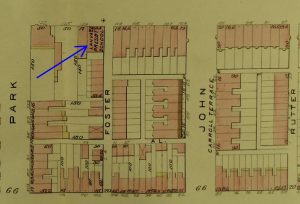
An 1885 map lists the site as home to the “Lanvale Presbyterian School.”
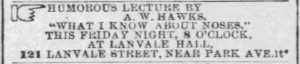
The building continued to be truly a “mixed-use” operation, hosting in 1886 a lecture by a humorist entitled, “What I know about noses.”
Yet another school was planned for the building in late 1890, this time the Oxford School for Boys. The record is unclear whether that one got off the ground. Meanwhile Mr. Martin, who had originally started Richland School, had left teaching and graduated from New York Theological Seminary in 1883. He died of typhoid fever in Anniston, Alabama in 1892, assigned to a church there.
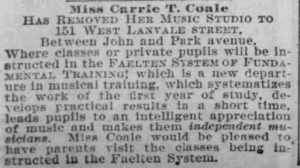
The building continued to be advertised for various uses into the early 20th century, when apartments and the grocery store became the most stable use. Miss Carrie Coale offered music lessons there as late as 1903. Justin Williams, a singer and pianist on faculty at the Peabody Conservatory, resided at 151 W. Lanvale, as did Howard Frech, an artist and illustrator.

It’s June now, the end of the academic year, so a story involving another teacher gives us a fitting conclusion to the Richland School. Bolton Hill once had another nearby school called Kornerstone Kindergarten, started by May Richardson and located within Memorial Episcopal church. Our neighbor Merry Rogers remembers “Miss May’s” kindergarten being operated out of Memorial’s parish house. She and her brother, Dick Roszel, would occasionally attend. Merry particularly recalls a field trip to the zoo with Kornerstone.
A woman named Maretta “Mary” Cannon taught at Kornerstone and lived at no. 151, with her aunt, Mary Cannon Smith. In December 1943, just before Christmas, a group of 35 Kornerstone students visited Ms. Cannon Smith at her apartment, singing Christmas carols.
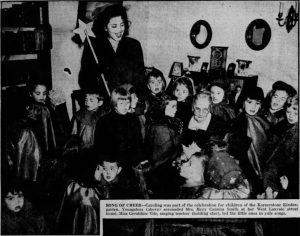
Excerpted from Dec. 12, 1943 Evening Sun article.
When the niece, Maretta “Mary” Cannon, died in 1963, her obituary recounted a bit about her work and background:
Miss Cannon, who taught by choice in the poorer sections of the city, pioneered programs at the turn of the century which took her young charges at school No. 48 outside the schoolroom. She started a “youth band” among her youngsters, brought pets into the classroom and started the first kindergarten classroom library. She was born at her parents’ plantation outside Natchez, Miss., and came to Baltimore after her parents died.
Today, 151 Lanvale maintains its connections to the education community largely as apartment housing for MICA students. It’s owned by former Bolton Hillers Adrian and Jennifer Goldszmidt.
Thank you to Dr. John C. McLucas, Kelly Knock, Merry Rogers and Charlie Duff for helping with this article.
–Kevin Cross
