
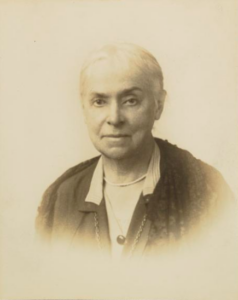
No Baltimore home is complete without local etchings, especially of our Washington Monument (the first such monument, of course). The works of Don Swann – senior and junior – are ubiquitous, and a municipal series by M. Paul Roche is nice as well. But few artists executed these scenes better than Gabrielle de Veaux Clements (1858-1948), who was at times a Bolton Hill resident.
In a Bulletin article last year, it was observed that Ms. Clements had resided on Linden Avenue in a block razed during “urban renewal.” Recently it was found that one of her many residences over the years still stands: at 1533 Bolton St. on the corner with McMechen Street. Michael Grant, an attorney, and Matthew Westrate, an architect, bought 1533 Bolton in 2022 and live there today.
Gabrielle was born in Philadelphia in 1858. She studied science at Cornell University, but also had a strong interest in art. Among her art teachers was Stephen Parrish, father of Maxfield Parrish, an American painter and illustrator active in the first half of the 20th century. Just ahead of Gabrielle at Cornell was Martha Carey Thomas, a Baltimorean who was, like Gabrielle, the daughter of a doctor.
Ms. Thomas was the companion of Mary Elizabeth Garrett, daughter of the president of the B&O Railroad. (It was Mary Elizabeth’s brother, Robert Garrett, who married Bolton Hiller Mary Sloan Frick, who developed the Garrett-Jacobs Mansion, now the Engineers Club in Mt. Vernon.) Martha Carey Thomas, Mary Elizabeth Garrett, and several other Baltimore women established the Bryn Mawr School for Girls in Baltimore. Mary Carey Thomas became Bryn Mawr’s president in 1885. The school was located where the Meyerhoff Symphony Hall sits today.
The Baltimore Sun wrote about Gabrielle’s appointment to the staff at Bryn Mawr in an Oct. 10, 1895. article describing her training and accolades. Five days later, a New York Times article noted her addition to the faculty, concluding, “The Bryn Mawr School is to be congratulated.”
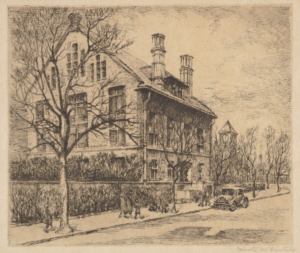
After starting at Bryn Mawr, in 1896 Gabrielle produced this well-known etching of the Washington Monument:
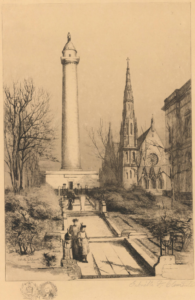
It was used as the frontispiece of Meredith Janvier’s 1933 book of reminiscences, Baltimore in the Eighties and Nineties, for which Bolton Hiller Gerald Johnson wrote the introduction.
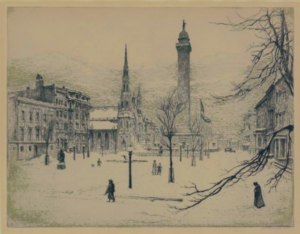
Another writer, Bolton Hiller Letitia Stockett, included Gabrielle’s 1925 etching “Winter, Mount Vernon Place” in her book Baltimore: a Not Too Serious History, available at https://babel.hathitrust.org/cgi/pt?id=umn.319510019610497&seq=43. The 1936 edition of that book included that etching as its frontispiece.
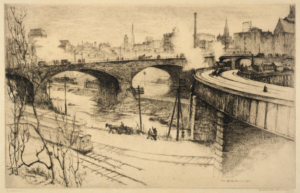
Another popular Clements etching, sometimes called “Where North Meets South,” shows the North Avenue bridge, looking south toward Bolton Hill from above the Streetcar Museum.
In April 1898, the Sun reported that Gabrielle had been selected to create a mural for Trinity Church in Towson. The article said the work “will be, it is believed, the first decoration of a church in Baltimore and vicinity by a woman in mural painting.” An article from September of that year explained that Gabrielle had been working on the mural in her “summer studio … at Gloucester, Mass.,” and that “[t]he intellectual motive for the decoration is found in the last Psalm.” The design would therefore include “a group of angels blowing trumpets and painted in rich colors, with the use of gold, to give the effect of an ancient painting.”
Ms. Clements’s mural can be seen today at Trinity Episcopal in Towson:
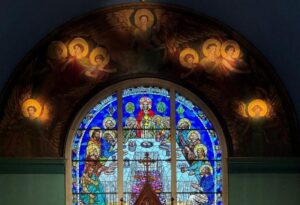
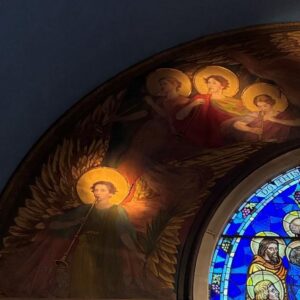
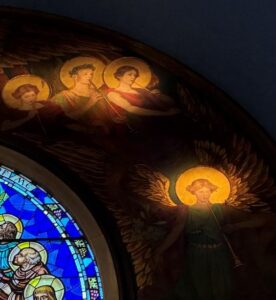
The mural complements the nearby Tiffany Studios windows at Trinity Towson. One particular work by Gabrielle also merits mentioning, a “color etching and aquatint” that sold for $1,100 recently at Swann Gallery in New York. It sheds light on the evolution of her work and artistic philosophy.
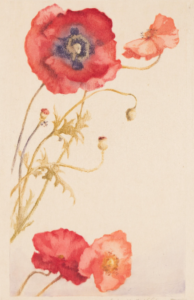
What appears to be this very piece was discussed by Gabrielle during an interview for an October 1923 Christian Science Monitor article. The article refers to a “vermillion poppy” that Gabrielle was working on. She described the advantages of her experimental techniques: It gives a more flower-like quality than any other process I know. The soft, delicate, indefinite outline of petals is preserved by allowing the color to flow just beyond the hard and fast drawn outline. You see the little stamens! Those would be fussy if done with a brush, but here they have the charm of the pencil drawing.
The expression “Boston marriage” was new to me when I began researching this piece, but it referred to a long-term, committed cohabitating relationship between two financially independent women. It has been used to describe the lifelong relationship between Gabrielle and Ellen Day Hale, a Bostonian she met in 1883 while the two were studying art.
The two summered at Folly Cove, near Rockport, MA. Based on contemporaneous Baltimore directories, it does not appear Ellen spent much time in Baltimore with Gabrielle – which brings us finally to the new finding about Gabrielle’s residence, facilitated by artificial intelligence research.
Experimenting using one of the A.I. platforms available, I created a collection of a few decades of public-domain copies of city directories. With this knowledge base, using the A.I. tool, one could efficiently search for information within all of the copies at once.
I knew Gabrielle. had resided on Linden Avenue, but I wanted to see what other addresses the directories had. That was just a moment’s work for the A.I. tool, and among the addresses it returned was number 1533 Bolton St listing Ms. Clements as a resident there in 1903, found in 1903 Polk’s Baltimore City Directory. The directory indicates she was living there along with Annie and Henry Marchant, a physician and a dentist.
Searching across multiple files at once can be done through Adobe PDF software, but it isn’t nearly as fast as A.I. tools, and for directories like these (the 1903 directory is 2,200 pages), would take ages to sift through one by one. While such automated analysis can be most useful for cut-and-dried fact research such as this, results still have to be verified, and the writing – of this piece at least – is left entirely to human hands.
Gabrielle died on March 26, 1948, and is buried in Folly Cove. An April 1948 Baltimore Sun tribute by a friend of Gabrielle described her as “[t]all and sturdy of frame, with snow-white hair and bright brown eyes,” adding that she “had decided opinions, did not hesitate to assert them vigorously, was clear-headed and practical in business arrangements, and never entertained the idea that the ravens would somehow provide.”
Thank you to my wife’s uncle and aunt, David and Mindy Hayes, for giving us our first Clements etching, “Where North Meets South.” Matthew Grant and his husband Michael Westrate kindly provided an ideal photo of their home. Trenton Carls, now with the Lexington (MA) History Museums, kindly provided information about Gabrielle’s place of burial when he was with the Cape Ann Museum. And thank you to Marisa Bourgoin (a Bryn Mawr College alum), Head of Reference Services at the Archives of American Art, Smithsonian Institution, for her research guidance regarding their archives.
–Kevin Cross
