
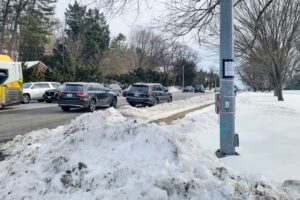
With colder weather ahead, BHCA’s president, Lee Tawney, did a deep dive into city laws and ordinances to find out who is responsible for what when it comes to sidewalks. What he found underscores that property owners bear most of the burden for dealing with snow, ice and related neighborhood issues.
Put succinctly, Bolton Hill property owners – not the city or Midtown – are legally responsible for maintaining, repairing, and clearing the sidewalks (footways) adjacent to their property. Property owners must clear snow and ice promptly after winter storms, or risk environmental citations and fines (up to $100 per citation). Footways must be at least 4 feet wide.
However, property owners are not responsible if sidewalk damage is caused by public right-of-way or trees in public space; in those cases, the city (in theory, at least) will handle the clearing and repair.
To avoid flooding and support foot traffic, the owner or person in charge of a property must keep any adjacent sidewalk and gutters free from waste, debris, and obstructions. Drainage from rain spouts or other sources should flow under instead of across the surfaces of public sidewalks.
Blocking a street, sidewalk, or gutter is prohibited, with limited exceptions for active business deliveries. That would appear to include placing objects in the street to block parking. Riding bicycles on sidewalks is prohibited, though one may walk a bicycle as long as it does not obstruct pedestrians.
Under an existing consent decree, the city is responsible for installing and maintaining ADA-compliant ramps at street crossings.
As for trees on city sidewalks:
- You must obtain a written permit from the Department of Transportation (in consultation with the Department of Recreation and Parks) before you spray, mulch, fertilize, trim, prune, remove, or otherwise treat any street tree or public tree well.
- Building raised-stone, brick, or wooden walls around street tree wells is illegal under city code if the structure impedes water or air flow to the roots, causes soil buildup or harms the tree. Open fences or borders that allow water flow are generally acceptable. According to Baltimore Tree Trust, tree wells in the public right-of-way should measure at least 4 by 8 feet to give roots adequate space, prevent sidewalk/pavement damage, and capture stormwater runoff. Homeowners are responsible for keeping nearby tree wells clean, free of litter and accumulated debris, and are expected to pull weeds and prevent overgrowth inside the tree pit. City code enforcement can cite properties for neglected, trash-filled, or overgrown tree pits.
- Under law, removing healthy trees on city property or rights-of-way is strictly regulated, and replacement of trees is covered by the Department of Recreation and Parks’ Forestry Division. While not legally mandated, residents are strongly encouraged to water street tree wells and apply a flat, ring-shaped layer of mulch (keeping it off the actual tree trunk). Residents must report dead trees, hazardous limbs, or sidewalk-blocking roots to 311 (by phone or via the 311 app) rather than attempting unauthorized major cuts or removals.
