
 Christy Fricks
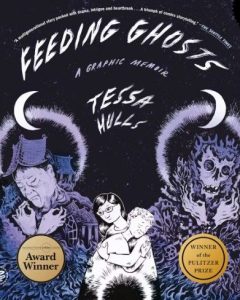
Title and Author: Feeding Ghosts by Tessa Hulls. Genre: Graphic Memoir
Why did you choose this book? A friend originally recommended it and then I saw it highlighted on a table at the bookstore. It’s not my usual read, but I’m so glad I picked it up. I highly recommend it.
What is it about? It is a multigenerational memoir told in a hauntingly beautiful graphic design style. It traces three generations of women through Chinese history as they eventually immigrate to Northern California. It is partially history and partially the story of overcoming inherited trauma.
What does this book do well? What qualities does it have that are unique, interesting or exceptional? Hulls’ choice to use her own hand drawn illustrations keeps an otherwise dense story from bogging down in information-heavy sections. Her unique voice and perspective shine through even as she traces how her life is deeply interconnected to both her mother’s and her grandmother’s history. This is only the second graphic novel ever to win a Pulitzer Prize, and it is easy to understand why. It is a book of epic proportions. Anyone who’s ever struggled with their relationship with their mother will relate to parts of this story.
What is your next read, and why? Avalon, Rise by Madeline Fitch. I was looking for an uplifting fiction novel. I heard her speak at the Baltimore Book Festival and thought I’d try this out.
Tell us about yourself in one sentence. I’m an MFA candidate in creative nonfiction writing at the University of Baltimore and a musician, dancer, and mother of four young adults.
 Julie Marx
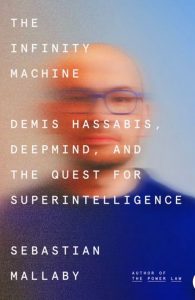
Title and Author: The Infinity Machine, by Sebastian Malaby. Genre: Non-fiction
Why did you choose this book? I would normally be telling you about a novel (and I do recommend Exit Strategy by Hilary St John Mandel – with thanks to neighbor Beth Fredrick for sharing it with me), but I’m reading non-fiction because my brother, who is also more likely to be reading fiction and who I pretty much only hear from if it’s about a book, highly recommended it. So, it’s a way to connect with him. It’s also topical, and one way I cope these days is to try to understand the humans driving all the greed, carelessness and cruelty that’s so prominent and powerful right now.
What is it about? Focused on Demis Hassabis – founder of Google DeepMind – The Infinity Machine tells the story of the personalities, ideas, science, and money behind the development of Artificial General Intelligence.
What does this book do well? What qualities does it have that are unique, interesting or exceptional? True confession: I’m mostly listening to this book. When I tried just to read it, I didn’t find it quite as compelling because … well, it’s not a well-written novel But, like a novel, it draws you in with complicated characters and compelling plotlines. Without making AI any less scary and real, it’s an engaging way to understand the roots of a highly technical, rapidly changing, and purportedly philosophical topic.
What is your next read, and why? Next up is Everything is Tuberculosis by John Green because that’s what my book club is reading. And, for fiction, maybe The Oresteia? Thanks to Christopher Nolan, I re-read The Odyssey (I don’t think I found it quite as page-turning back in college as I did this time) and there was a copy of The Oresteia at Festival on the Hill, so … we’ll see.
Tell us about yourself in one sentence. I’m a retired high school government and history teacher and have lived in Bolton Hill since 1996.
